The first thing I want Vestige to do is make me want to play. That sounds simple, but it changes almost every worldbuilding decision. I am not building Vestige because I want to write an encyclopedia of future history. I am building it because I want a science-fiction setting that can hold solo tabletop gaming, RPG campaigns, miniature wargaming and strange little hobby experiments without making every game feel like it belongs to a different universe. That practical side matters. Vestige has to help me put models on the table, frame a mission, ask an oracle a better question or give an RPG crew somewhere interesting to go. The philosophy only matters if it keeps pointing back to play.
The story begins when you start playing.
That is the central idea I keep coming back to. The setting should give me enough structure that a mission feels like it belongs somewhere, and enough texture that a ruined facility, engineered soldier or frontier settlement feels connected to a larger history. But it should not try to answer every question before the first dice roll. If Vestige becomes too complete, it stops being useful in the way I need it to be useful. It becomes something to read around instead of something to play inside.
One big idea
Every setting needs one big idea strong enough to support many smaller ones. For Vestige, that idea is this: life itself became programmable. That does not mean every article needs to become a biotechnology lecture. It means the foundation of the setting is that humanity learned to treat living bodies, inherited traits, adaptation and identity as things that could be designed.
Once that idea exists, many other parts of the setting begin to make sense. Humanity spreads into environments it was never naturally suited to survive. Some people are altered for labour, some for war, some for governance, some for exploration, some for endurance in places ordinary bodies would fail. Over time those designs become communities. Communities become cultures. Cultures inherit old purposes, reject them, misunderstand them, ritualise them or build new lives around them.
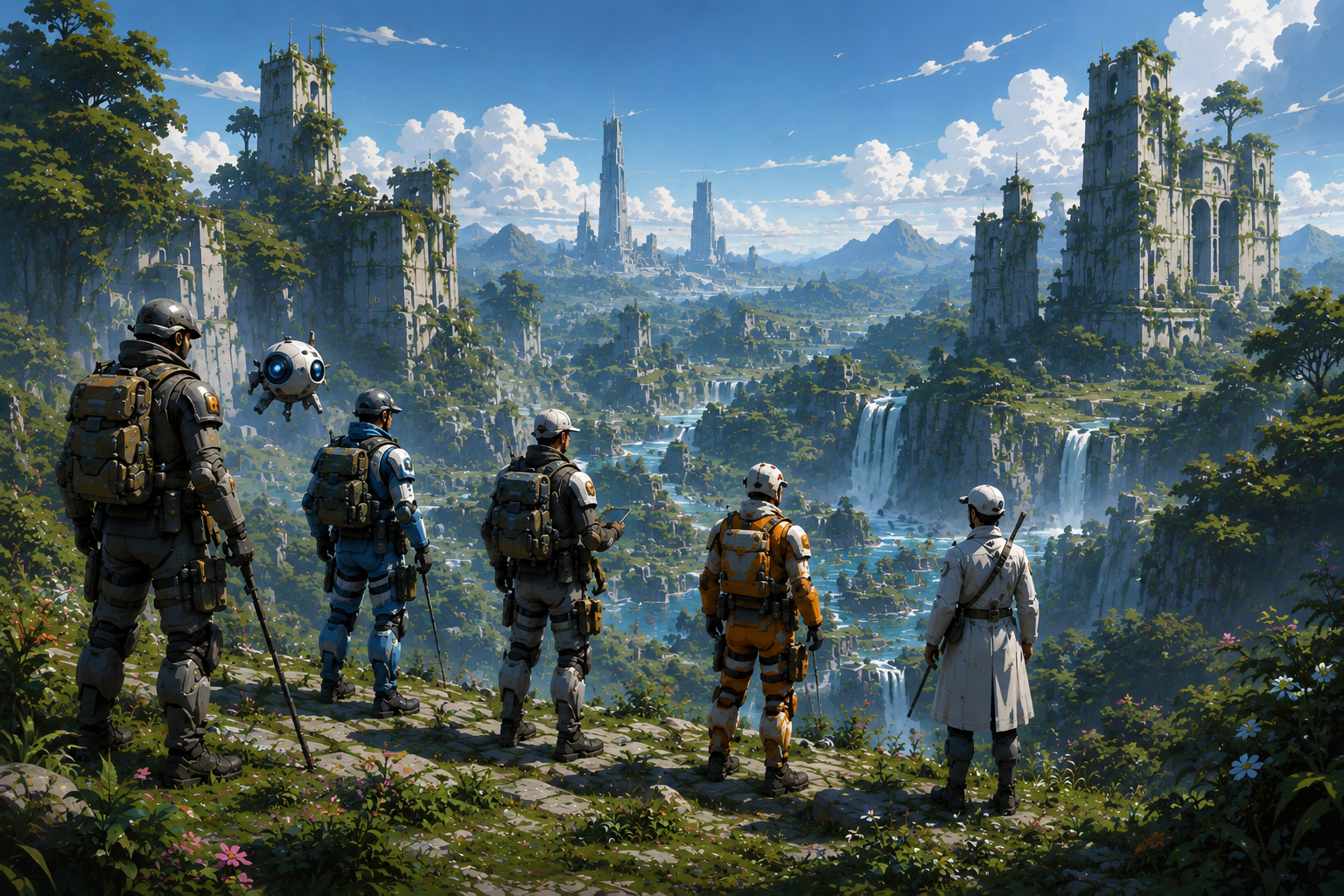
That is much more useful to me than starting with a catalogue of separate alien species or disconnected miniature ranges. If I place a heavily armoured soldier, a recon operative and a rugged industrial worker on the table, I do not need them to come from three unrelated settings. They can all be descendants of the same enormous human project, shaped in different directions by different needs.
The big idea gives the miniatures somewhere to belong.
It also gives future stories room to breathe. Programmable life can support frontier medicine, engineered ecosystems, military Patterns, social prejudice, inherited obligations, failed experiments and ancient systems that still treat people as components in designs nobody fully understands. I do not need to explain all of those at once. I only need each new story to feel like it grows from the same soil. That is the kind of worldbuilding I find most useful for games: one clear pressure at the centre, many possible consequences around it.
Enough answers, not all answers
I like settings that know what to leave unexplained. Players need enough information to understand what kind of world they are moving through. They need to know what is normal, what is dangerous and what people want. Without that, nothing has weight because nothing has context.
But if everything is answered, the world loses a different kind of strength. It becomes too well lit. Every ruin has a paragraph. Every ancient machine has a designation. Every lost civilisation has a timeline, a cause of collapse and three named successor states. There is comfort in that kind of completeness, but it can also make the setting feel smaller.
Vestige needs mystery because mystery creates motion. An ancient structure on a dead moon should not always arrive with a clean explanation. A sealed vault should not always tell you who built it, what it was for and why it failed. A forgotten war should not always have a clear winner. Some ruins should remain ruins because their unknown history is what makes them useful.
That is intentional, not unfinished. The people living in Vestige do not know all of these answers either. They inherit partial maps, damaged archives, local myths and technical systems whose original purposes may be long gone. Mystery is not the absence of worldbuilding. It is worldbuilding with room left for discovery.
This is especially important for solo play. When I play alone, I want the game to surprise me. I want an oracle roll, a random event, a bad tactical decision or a strange objective to imply something I had not prepared. If the setting has already answered every important question, those surprises have fewer places to land. There is a difference between an empty blank and a productive mystery. An empty blank gives the player nothing to work with. A productive mystery gives shape, pressure and clues, then leaves the final meaning open until play demands it.
Older than the story
I often think about The Hobbit when trying to understand this. Vestige is not trying to imitate Tolkien in genre, tone or structure. What matters to me is the feeling that Middle-earth has while you are reading The Hobbit. The world feels old. Songs, swords, ruins, maps and names all suggest that the story is moving through the remains of things that began long before Bilbo left home. But while reading The Hobbit, the exact dates of ancient history are not the point. You do not need a chronological table beside you to care about the journey. You do not need to know every age in detail before the old roads, dark forests, lost kingdoms or lonely mountains can matter. The oldness is doing emotional and imaginative work. It gives the present story depth without asking the reader to stop and study for an exam.
That is the lesson I want to borrow for Vestige. The setting should feel older than the mission being played. A frontier settlement should feel like it was built on top of previous failures. A working machine should feel like it may be the last surviving part of a larger system. A Clade should carry traces of its original purpose even if the people living now have their own desires, politics and private problems.
History matters because it supports the present. It gives weight to the room the characters are standing in. It tells us why the colony fears the sealed lower levels, why the old orbital elevator is treated like a shrine, why a retired Shield is both respected and avoided. Those details are useful because they affect play now.
The exact year a civilization fractured may not matter. The fact that it fractured matters a great deal. The exact sequence of expansion, collapse, recovery and drift can stay loose until a campaign needs a sharper answer. What matters first is that the people in the present live among consequences.
Principles over timelines
I understand the appeal of giant timelines. They make a setting feel serious. They promise order. They give the comforting sense that everything has already been placed somewhere. There is nothing wrong with that. Some settings are at their best when they feel like vast archives, with dynasties, wars, migrations and technological ages carefully arranged for the reader to explore.
That simply serves a different purpose from Vestige. Once a timeline grows too large, every new faction, event, technology or miniature project has to negotiate with it. Where does this fit. Which century invented that. Why did nobody mention this earlier. How does this new idea affect the five things already dated around it. That can be fun if the timeline is the project. For Vestige, it is not. Vestige is meant to generate adventures rather than catalogue every historical event.
Vestige is being built to support play, so I would rather begin with principles. Humanity uses biotechnology. Civilization expanded. Civilizations fractured. People rebuilt. Not everything was recovered. Not every surviving system is understood. The present is full of inherited tools, damaged institutions, local adaptations and dangerous leftovers.
Those statements are enough to generate a great deal of play. They explain why two human groups can look very different and still recognise each other as human. They justify a battlefield where old military hardware, local militia, engineered operatives and unknown organisms all appear without needing four separate universes stapled together.
If a campaign later needs a named era, I can create one. If a mission discovers that a particular colony was founded during a specific wave of expansion, that can become true. The setting can become more detailed where play applies pressure.
That feels healthier than trying to write thousands of years of history up front and then spending every future article carefully avoiding contradictions with material that has never actually reached the table.
Let games create history
The campaigns played on the tabletop should become history. This is one of the most important design choices in Vestige. The world is not meant to arrive complete, with play serving only as a tour through things I already decided. The world should grow from what happens in games.
If a player’s crew discovers an ancient vault beneath a silent colony, that vault becomes part of their Vestige. Its builders, contents and consequences can ripple outward. Maybe the discovery changes the settlement. Maybe it draws attention from people who should not know about it.
That is what I want from my own games as well. If my Five Parsecs crew discovers an ancient facility during a mission, I want that discovery to become part of Vestige rather than feel like a contradiction I have to explain away. The setting should be sturdy enough to receive what play gives it.
That is history being made. If a retired Shield saves a colony during a desperate attack, that becomes history too. Not because I wrote it in a master timeline beforehand, but because the dice, the scenario and the choices at the table made it happen. Later, people may remember the event badly. They may exaggerate it, turn it into a local holiday or use it as a reason to fear the return of old military authority.
The same thing can happen with failures. A survey team might open the wrong door. A settlement might be abandoned because the rescue came too late. A campaign can leave scars on the setting, and those scars are more useful to me than a pristine official chronology.
This also makes Vestige easier to share with different games and model collections. My version can grow from my missions. Someone else’s version could grow from theirs. The core principles keep the setting recognisable, but the lived history comes from play.
Possibility beyond the next jump
Every unanswered question is an invitation. That does not mean Vestige should be vague. I want enough definition that discoveries have meaning. A strange organism matters more when we understand what ordinary engineered life looks like. An ancient ruin matters more when we know humanity has already spent generations misreading older technology. Possibility works best when it has edges.
The purpose of those edges is to make exploration rewarding. When a crew crosses into an unmapped system, I want the question to be more interesting than “what random thing is here?” I want it to be “what part of the setting’s larger pattern is being revealed, distorted or broken here?” That is why Vestige should invite exploration rather than memorization.
I do not want readers to feel that they need to learn the correct answer before they can play. I want them to feel that there is always another mystery beyond the next jump point, another settlement making do with inherited systems, another ruin that refuses to explain itself, another old decision still shaping lives long after the people who made it are gone.
The setting should make players curious. It should give them reasons to ask questions at the table. What happened here. Who benefits if this remains buried. Why does this machine still recognise one Clade but not another. Those questions are more valuable to me than a finished answer key.
Where this leaves Vestige
Vestige is still early, and I like that. The setting has a foundation: programmable life, engineered humanity, fractured expansion, old remnants and a present shaped by things that were never fully recovered. That is enough to begin. It gives me a way to connect miniatures, frame missions and imagine worlds that feel lived in. The rest should come through use. Some ideas will deserve full articles later. Some will remain background pressure. Some will appear once in a mission and then become important because the game made them important.
I want Vestige to feel like a place where stories are waiting, not a place where all the best stories already happened off-screen. The old civilizations can stay partly hidden. The technologies can remain partly misunderstood. The ruins can keep some of their silence. The campaigns can decide which mysteries matter, which names survive and which events become part of the remembered past.
Vestige is a universe for discovering stories, not reading their complete history.