Vestige is the name I am using for the shared science-fiction setting behind my current and future miniature projects. It exists for a simple reason: I want my different forces, campaign frames, hobby experiments and solo games to belong to the same universe even when the models themselves come from very different ranges.
I do not want to keep starting from scratch every time I change systems or put a different group of miniatures on the table. I also do not want to force those projects into borrowed settings that bring in far more lore than I actually need. What I need instead is a setting that is broad enough to hold reconnaissance teams, ruined colonies, military expeditions, explorers, strange survivals and local wars without demanding a complete encyclopedia before the first game begins.
Vestige is a setting where humanity learned to reshape itself long before it understood the universe it had entered.
This article is not a full history of that setting. It is the starting point: the basic frame I can use now, and expand later through actual play.
Why I am building it
Most of my science-fiction collection was bought because I liked the models, not because I wanted to commit myself to one company’s setting forever. Some pieces suggest military operations. Others look better suited to exploration teams, private crews, failed colonies or posthuman societies. I want room for all of that.
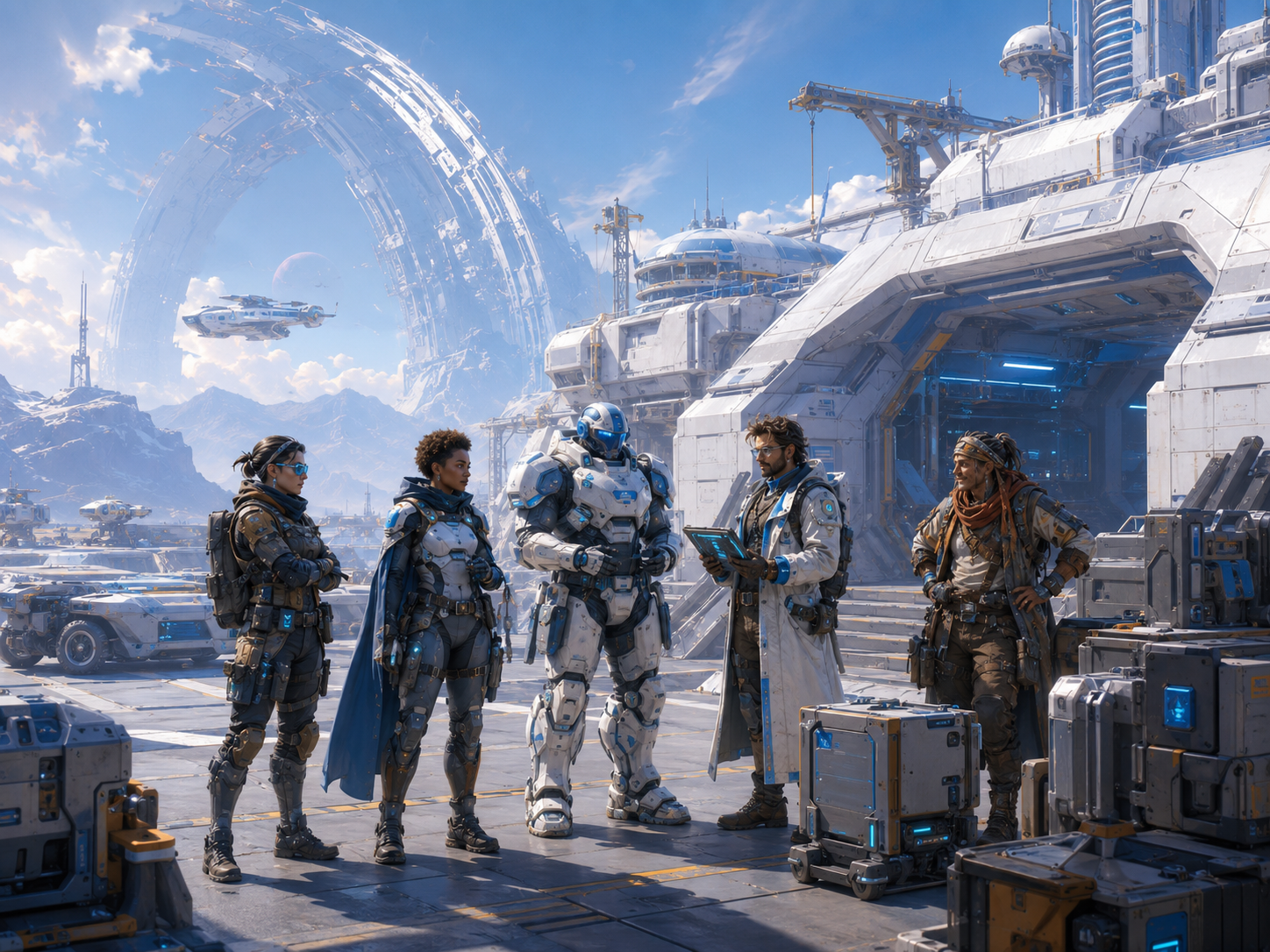
Vestige gives me a way to treat the miniatures as visual components of one larger setting instead of a shelf of unrelated projects. A recon exosuit team can exist in the same universe as a colony militia, a survey expedition or a group of engineered labourers because the setting was built for that from the beginning.
That also means the setting only needs to answer the questions that matter at the table. Who are these people. What kind of society produced them. Why are they here. What do they want. What remains after something larger has already failed, withdrawn or changed.
Humanity spread and changed itself
The core idea behind Vestige is that most of the setting’s humanoid populations are not separate alien races. They are human.
Humanity spread far beyond its point of origin and did not remain biologically uniform while doing so. Instead, it engineered specialised branches of itself to suit different forms of labour, war, governance, adaptation and survival. Some designs were made for hostile environments. Others were built for endurance, prestige, technical work or extreme operational roles. Over time those branches became stable societies in their own right.
Humanity also learned that it was not the first great civilisation to leave large marks on the stars. Humans collectively call those older beings the Precursors, whether they would use that name for themselves or not. Their civilisation is no longer dominant and no longer moves with one purpose, but it is not entirely gone. Enormous structures, damaged systems, altered worlds and objects with no clear place in current human knowledge still shape how people travel, settle and interpret the past. Some of those remnants are abandoned. Some are still maintained. Humanity studies them, imitates them and often misreads them. The Ascendant Clade, in particular, reflects part of that long attempt to approach something humanity believes the Precursors once represented.
The formal term for one of these major engineered branches is Clade.
Within each Clade, specific engineered designs are called Patterns.
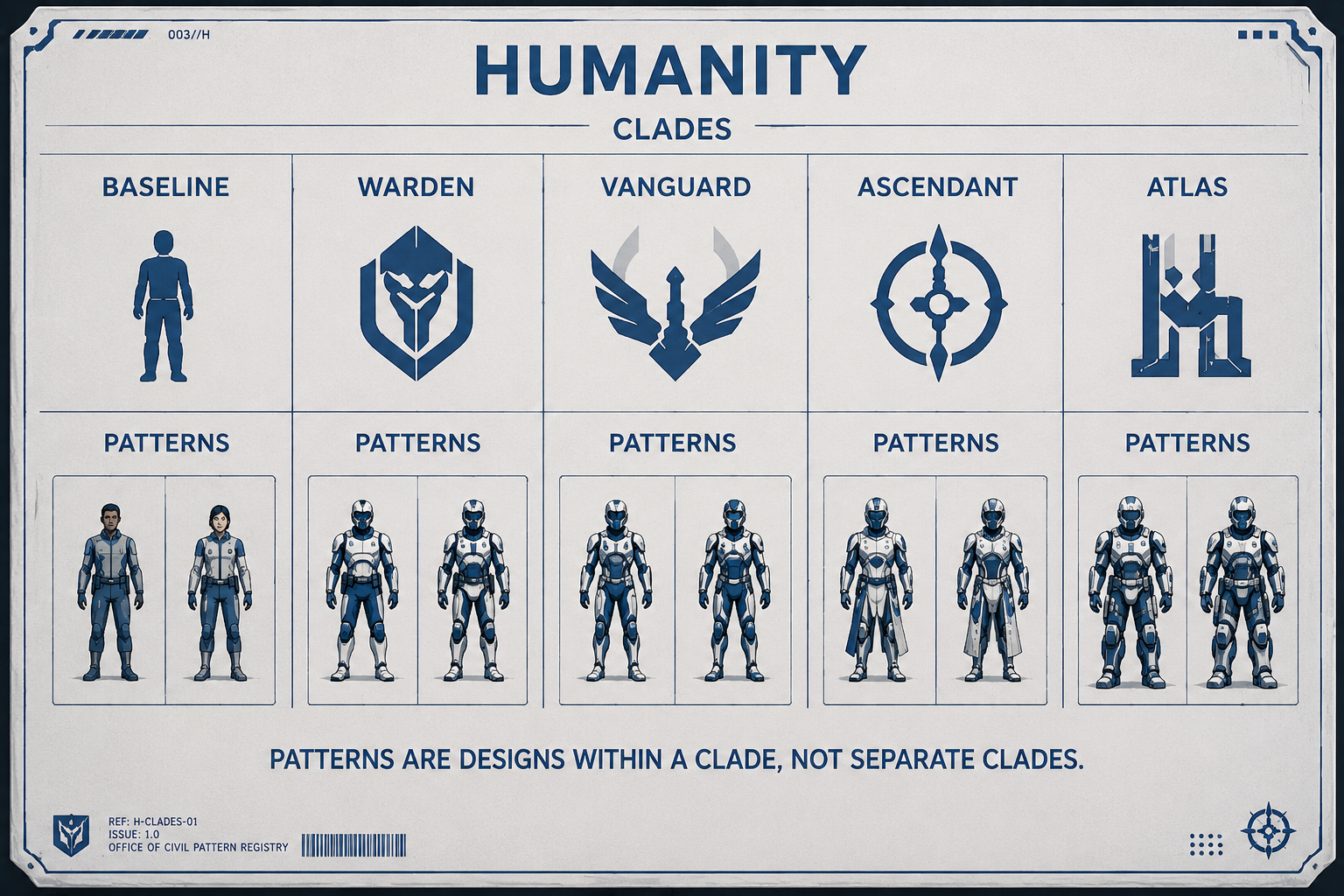
That distinction matters to me because it gives the setting a cleaner structure. A Clade is the broad human branch: a major engineered line with its own biological direction, historical role and social weight. A Pattern is a more specific design within that Clade. It may reflect a different generation, phenotype, environmental adaptation or operational specialisation, and it may have been created in a different period or by a different institution. A Pattern is not a separate species, not a separate Clade, and not simply a military unit or a suit of armour.
Patterns let me build meaningful variation without inventing a new Clade every time I want different proportions, capabilities or design history. Older and newer Patterns can continue to exist at the same time, and two people from the same Clade may belong to different Patterns while still being understood as part of the same broad human branch. A Pattern is closer to a family of related biological designs than a single miniature, armour suit, military unit or job. It can include inherited physical traits, neurological tendencies, environmental tolerances and compatibility with specialised equipment, but it does not erase individual differences in culture, training, personality, experience or local modification.
The Warden Clade is the clearest example in my current collection. Different power-armoured miniatures can represent different Warden Patterns rather than different peoples. Older ornate or archaic power-armoured figures can stand in for an older Warden Pattern. Classic Firstborn-style models can represent a later established Pattern. Primaris-style models can represent a newer, larger or more refined Pattern. They are still all Wardens. The point is not that one helmet shape or armour mark creates a new Clade, but that the Warden Clade can contain multiple generations of engineered military design.
The same logic applies to the Vanguard Clade. Fire Warrior-style models, Pathfinder-style models and Stealth Suit-style models should not read as three separate peoples. They make more sense as different Vanguard Patterns and operational designs within the same Clade. One Pattern may be better suited to direct combat, another to forward reconnaissance or target acquisition, and another to infiltration using specialised exosuit support. Equipment matters here, but equipment and Pattern are not identical. A suit can support a role, while the Pattern describes the engineered human framework that makes that role practical in the first place.
Atlas follows the same principle even when the differences are less visually familiar. One Atlas Pattern may be built for terraforming and atmospheric processor maintenance, while another is better suited to high-gravity construction, toxic industrial recovery or deep mining. Those differences can be physical and technical at the same time without turning each variant into a separate Clade.
This also means that similarity and difference can coexist in more useful ways. Two groups may still recognise each other as human while looking, thinking and living very differently. More importantly for this project, it gives me a practical way to fit different miniature designs into Vestige without pretending each visual variation needs its own separate species or civilisation.
That practical side matters quite a lot to me. When I add another miniature to the collection, I usually do not need another civilisation to justify it. Most of the time I only need another Pattern, another local variation or another specialised role inside something that already belongs to the setting.
The older shape of the setting
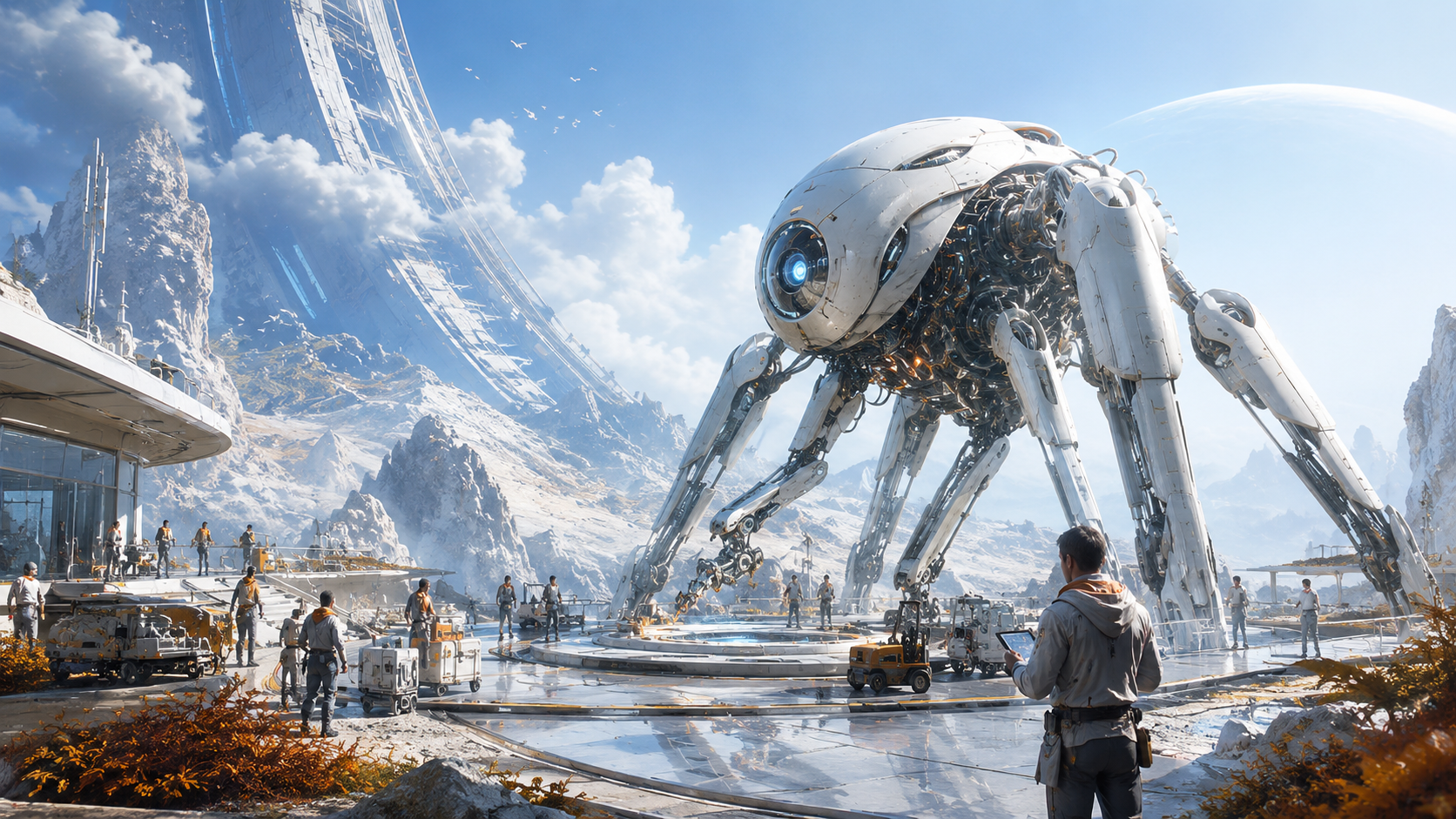
Vestige is not a clean age of expansion. It takes place after too much has already happened.
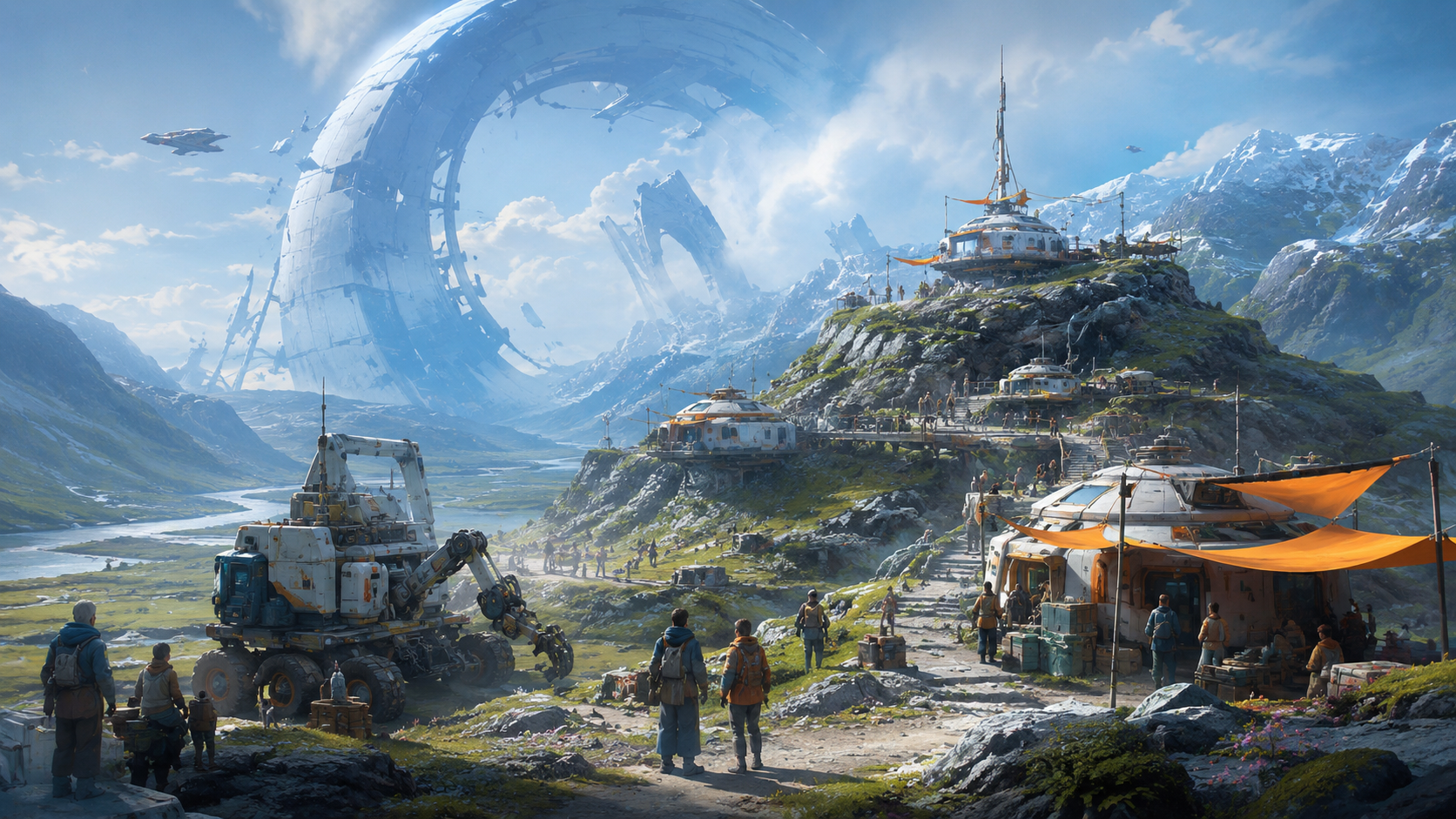
The great phases of settlement, engineering and interstellar ambition are in the past. Their infrastructure remains. Their descendants remain. Their military tools remain. Their archives, ruined stations, sealed colonies and half-understood systems remain. Not all of them still function, and not all of them were left behind intentionally. Some ancient installations are still watched by isolated individuals, hidden communities or remnants that no longer seem answerable to any wider civilisation.
Most intelligent beings humanity deals with in ordinary life are still human Clades rather than separate alien peoples. That does not mean the setting is empty beyond humanity. Indigenous life exists, and genuinely alien intelligences may exist as well, but both are intentionally uncommon. What people usually encounter are settlements, ruins, biological adaptations, failed systems and the lingering consequences of older civilisations rather than a crowded field of rival empires.
That is the condition I want the setting to begin from.
I am more interested in recovery, misinterpretation, salvage, decline, adaptation and partial continuity than in a triumphant golden age. A frontier settlement may still depend on machinery whose original makers are long gone. A Clade may preserve rituals built around technical processes it no longer fully understands. A military unit may still operate within a command tradition that outlived the state that created it.
There are also things that do not fit comfortably into any of those categories. Deepborn, Broken Wardens, esoteric manifestations, ancient green relics and signs of things older than the Precursors all belong at the edge of the setting. I do not want to explain them too early. What matters at this stage is that humanity still finds phenomena it cannot classify properly, even after mastering so much of itself.
Those are the kinds of things I want to discover through campaigns. The setting should feel inhabited by consequences rather than explained by a single master document.
The known Clades
These are the Clades I want to define first because I already own models that fit them. They are not the only ones that can exist, but they are the most useful place for me to start.
Baseline
Baselines are the majority population across much of human space. In ordinary speech they are simply Humans, and in many places the distinction only becomes explicit when another Clade is present.
That does not mean Baselines are unchanged or historically untouched. It only means they remain closest to the general human form from which the other engineered branches diverged. Most civilian institutions, trade networks and ordinary settlements I create will probably be built around Baseline populations unless there is a reason not to do so.
Warden Clade
Wardens are humanity’s final military answer to threats that ordinary forces cannot contain.
They are not routine line troops and should not feel common. If Wardens have been deployed, something has already gone badly wrong. They exist for containment, shock response and decisive force at the edge of failure. That makes them useful in the setting not just as powerful soldiers, but as a sign that the situation itself is serious enough to justify them.
In military slang they are sometimes called Shields, which says something about how they are viewed. A Shield is sent when the line must hold even after the rest of the plan has started to collapse.
Vanguard Clade
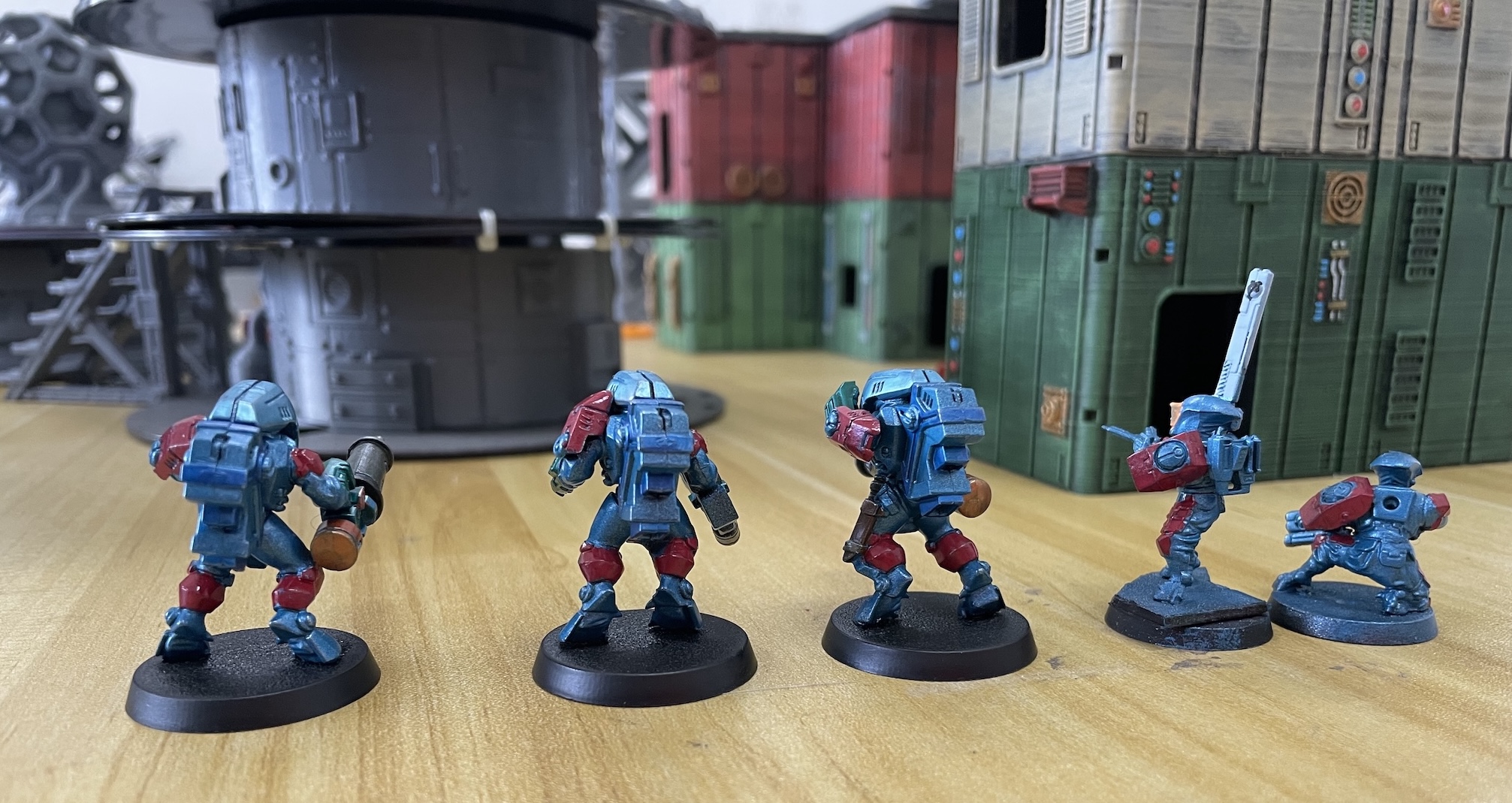
The Vanguard Clade exists for reconnaissance, precision operations, forward survey work and dangerous first entry.
These are the people sent where information is scarce and speed matters more than mass. They receive advanced equipment, but the more important point is their role. They are the eyes that arrive first, the ghosts moving through uncertain ground, the specialists asked to see clearly before everyone else commits.
That makes them especially useful for the kinds of small campaigns I want to run. Frontier exploration, first contact, infiltration, survey operations and limited military actions all fit them naturally. Their common slang names, Eyes and Ghosts, both feel appropriate for that reason.
Ascendant Clade
The Ascendant Clade represents one of humanity’s most refined attempts to redesign itself toward longevity, control and cultural authority.
They are elegant, long-lived and politically influential, but I do not want them reduced to simple aristocrats in space. What interests me more is the way they might embody deliberate self-improvement taken so far that it becomes a civilisational identity. They are not merely wealthy people with better implants. They are a branch of humanity shaped to rule, preserve, curate and endure.
Many Baselines speak of them with a mixture of admiration, resentment and suspicion. Slang such as Silks and Spires captures that distance well enough without needing further explanation every time they appear.
Atlas Clade
The Atlas Clade was engineered for planetary construction, environmental engineering, industrial recovery, terraforming and hazardous infrastructure work on a scale ordinary humans could not sustain for long.
They are immensely strong and resilient because they were designed for places where the work itself could kill less specialised people. They are also technically capable because the work they do demands it. Making a hostile world habitable, recovering a damaged industrial zone or keeping a vast atmospheric system functioning requires more than strength.
That does not make them simple brutes. If anything, an Atlas settlement should reveal how much engineering judgment, field knowledge and organisational competence is hidden inside this kind of work. Building a colony, opening a mine, stabilising an atmosphere processor or raising prefabricated infrastructure in a hostile climate all require skill as much as strength.
Their common nickname, Bricks, can be dismissive or affectionate depending on who is using it. I expect some Atlas communities to reject it and others to wear it proudly.
What the setting is for
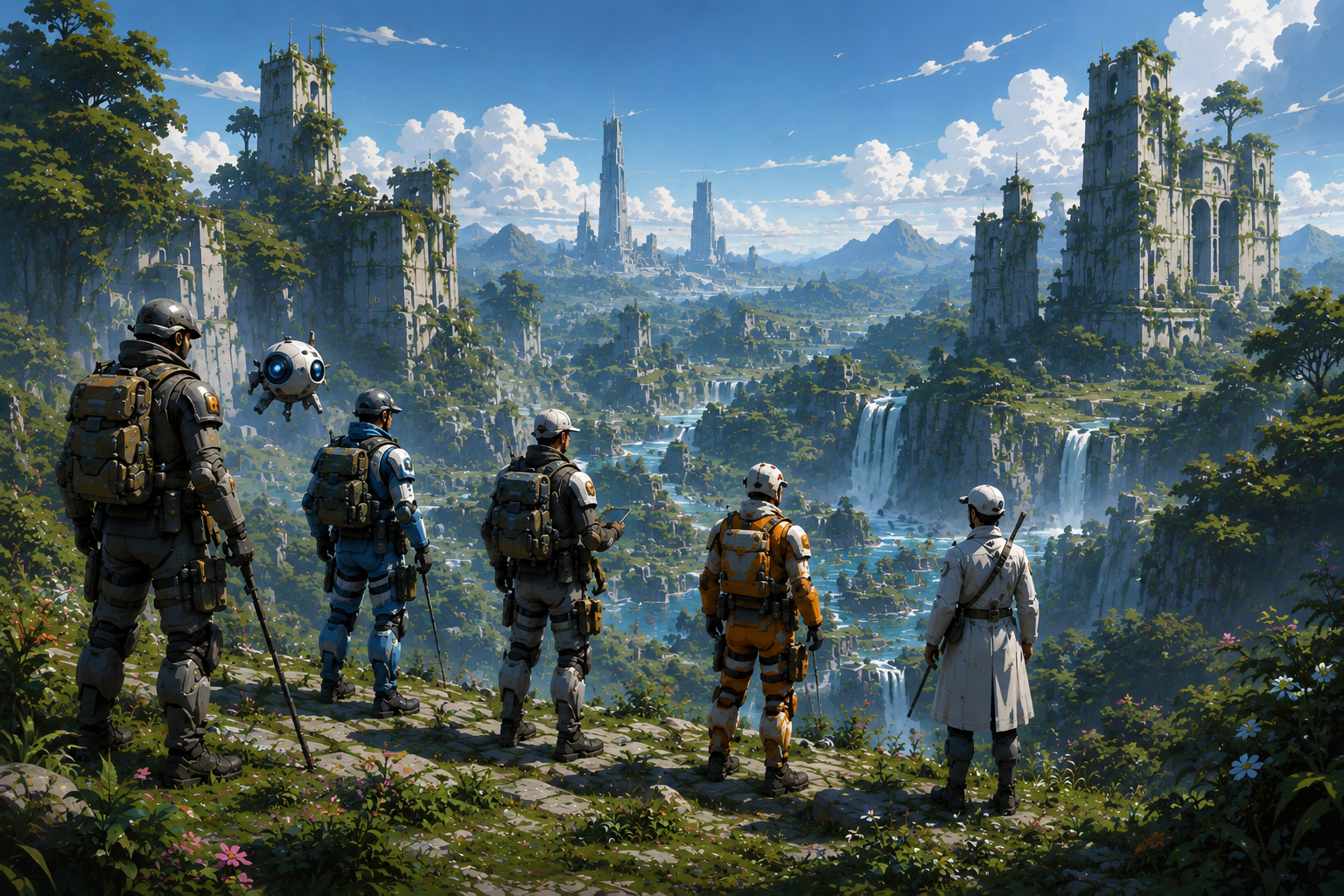
Vestige exists to support play.
That sounds obvious, but it affects what kind of setting material is useful to me. I do not need every century mapped out before I can run a recon mission on a silent colony world. I do not need every Clade subdivided into dozens of named Patterns before I can decide what kind of soldiers are opening a sealed facility. I need enough structure that the local details feel like they belong to something larger.
That is also why I want the setting to stay open around the edges. Different campaigns can illuminate different parts of it. One story may centre on a Vanguard survey team exploring failed settlements and older ruins. Another may focus on an Atlas work crew holding together a dangerous outpost. A Warden deployment should mean something very different from either of those. The same setting can hold all three if it is built from role, consequence and history instead of a single narrow premise.
It also gives me a place for miniatures that would otherwise remain disconnected. A model only needs a believable role inside Vestige to become usable. The setting does the work of context without demanding that every force inherit somebody else’s canon.
Where it starts
For now, Vestige begins at a manageable scale.
It begins with expeditions, outposts, damaged systems, inherited structures and Clades meeting each other far from any secure centre. It begins with people trying to understand what remains, what still works, what should be recovered and what should have stayed buried. It begins with small forces on specific missions, because that is what I am most ready to put on the table.
The rest can grow from there.
I do not need a complete setting bible before the first campaign. I need enough of a world that my different projects can start speaking the same language. The point is not to explain every mystery before play begins, but to make the first mission feel like it belongs to something larger.
Vestige begins with a mission, not an empire.